Hair Follicle vs Hair Shaft: What Is the Difference?
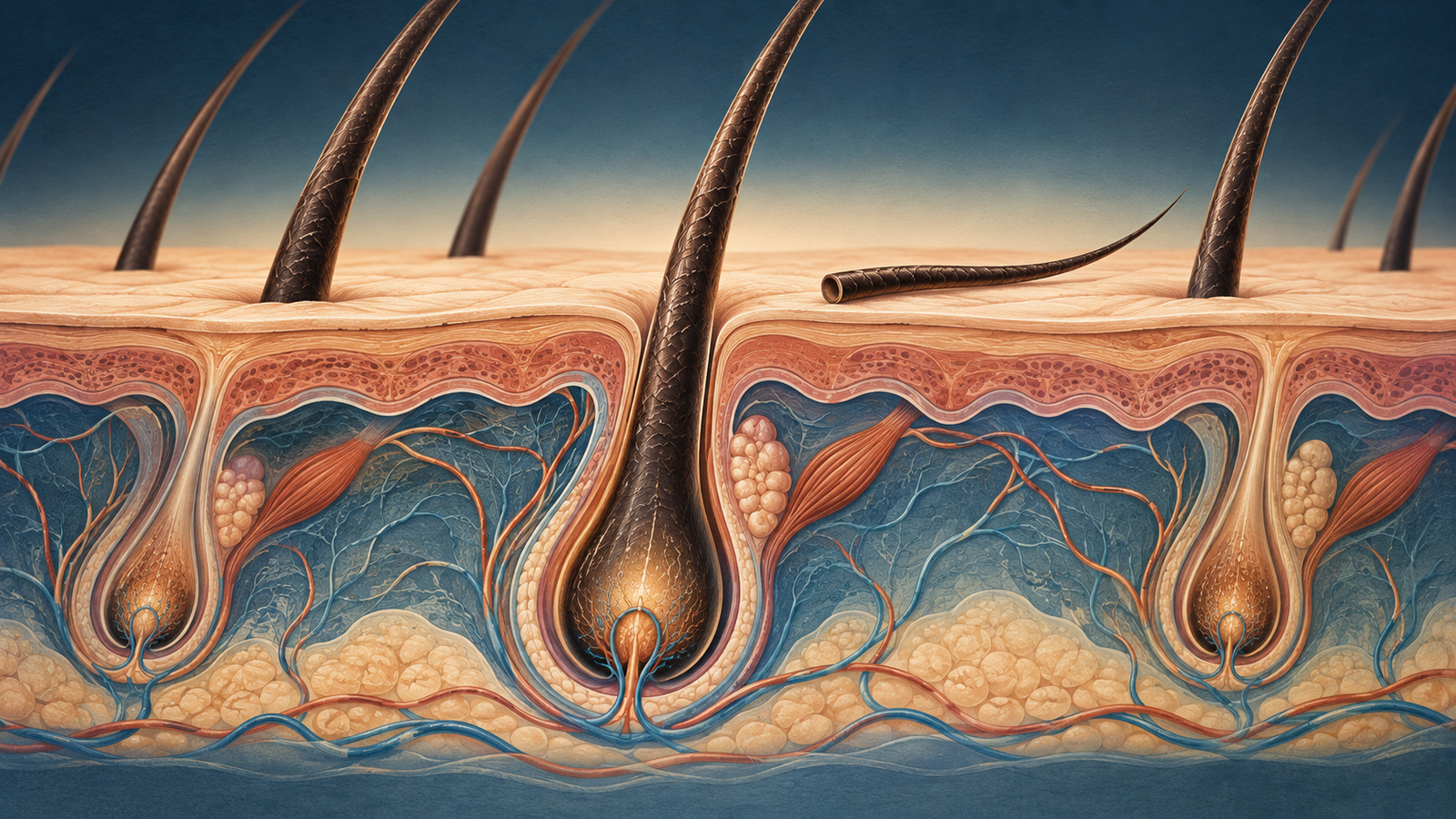
Hair follicle vs hair shaft describes the difference between the structure beneath the skin that produces hair and the visible strand that we wash, cut and style. These terms are often used as though they mean the same thing, but they refer to two different parts of the hair system.
This distinction helps explain why a shed hair does not always mean permanent loss, why thinning can occur even when follicles remain present and why one hair-transplant graft may contain more than one hair.
Hair Follicle vs Hair Shaft: The Structural Difference
The hair shaft is the part visible above the skin. It consists mainly of hardened keratinised cells. Its thickness, colour, curl and texture affect how much coverage the hair appears to provide.
The follicle is located within the skin. It surrounds the root and contains the biological structures involved in producing a new hair. A simple way to understand the relationship is to think of the follicle as the production site and the shaft as its visible product.
The Cleveland Clinic describes the follicle as a tube-like structure in the skin from which a strand of hair grows. The follicle can move through periods of active growth, transition and rest. The shaft it produces eventually sheds, while the structure beneath the skin may remain capable of producing another one.
This is also why cutting the hair does not affect the follicle. The visible shaft can be shortened without changing the growth activity taking place beneath the surface.
The thickness of the shaft still matters. Thick hairs provide greater visual coverage than fine hairs, even when the number of follicles is similar. When susceptible follicles undergo miniaturisation, they begin producing progressively thinner and shorter shafts. The scalp can therefore look less dense even before many follicles have completely stopped producing hair.
The article on androgenetic alopecia and telogen effluvium explains how gradual miniaturisation differs from excessive shedding.
Does a Shed Hair Mean the Follicle Is Gone?
Usually, it does not. At the end of a growth cycle, a hair shaft can separate and fall while the follicle remains in the skin.
People sometimes see a small white or translucent bulb at the end of a shed hair and assume that the entire follicle has been pulled out. In most cases, that visible part is associated with the hair root rather than the complete follicular structure.
The follicle lies deeper in the skin and cannot normally be removed by ordinary washing, brushing or shedding. It may later return to an active phase and produce a new shaft.
This does not mean every form of hair loss is temporary. Some follicles gradually become less productive through miniaturisation. Certain inflammatory or scarring conditions can permanently damage them. The important point is that the hair visible in the hand or sink does not, by itself, reveal what is happening beneath the skin.
That question requires the pattern, history and condition of the scalp to be considered together.
Why the Difference Matters in Hair Transplantation
The hair follicle vs hair shaft distinction becomes particularly important when graft numbers are discussed. A graft is not automatically the same as a single hair.
Scalp hair naturally grows in small groups known as follicular units. One unit may produce one, two, three or sometimes more shafts. During an FUE hair transplant, these units are extracted from the donor area and placed where coverage is needed.
Two patients may therefore receive the same number of grafts but not the same total number of hairs. The visual result will also be affected by shaft thickness, curl, colour contrast, graft survival and the way those units are distributed.
Single-hair units are especially useful along the front edge of the hairline, where a softer transition supports a natural appearance. Units containing more hairs can contribute greater coverage behind that edge. Planning involves understanding not only how many grafts are available, but what those grafts contain and where they can be used most effectively.
The distinction also matters after the procedure. Some implanted shafts may shed during the early weeks, causing patients to worry that the transplant has failed. The visible hair can disappear while the follicle remains beneath the skin and later begins a new growth phase.
The hair we see is the result of a process taking place below the surface. Understanding that difference makes shedding, thinning and graft numbers much easier to interpret.