Hair Transplant Consultation: What Should Happen Before Surgery?
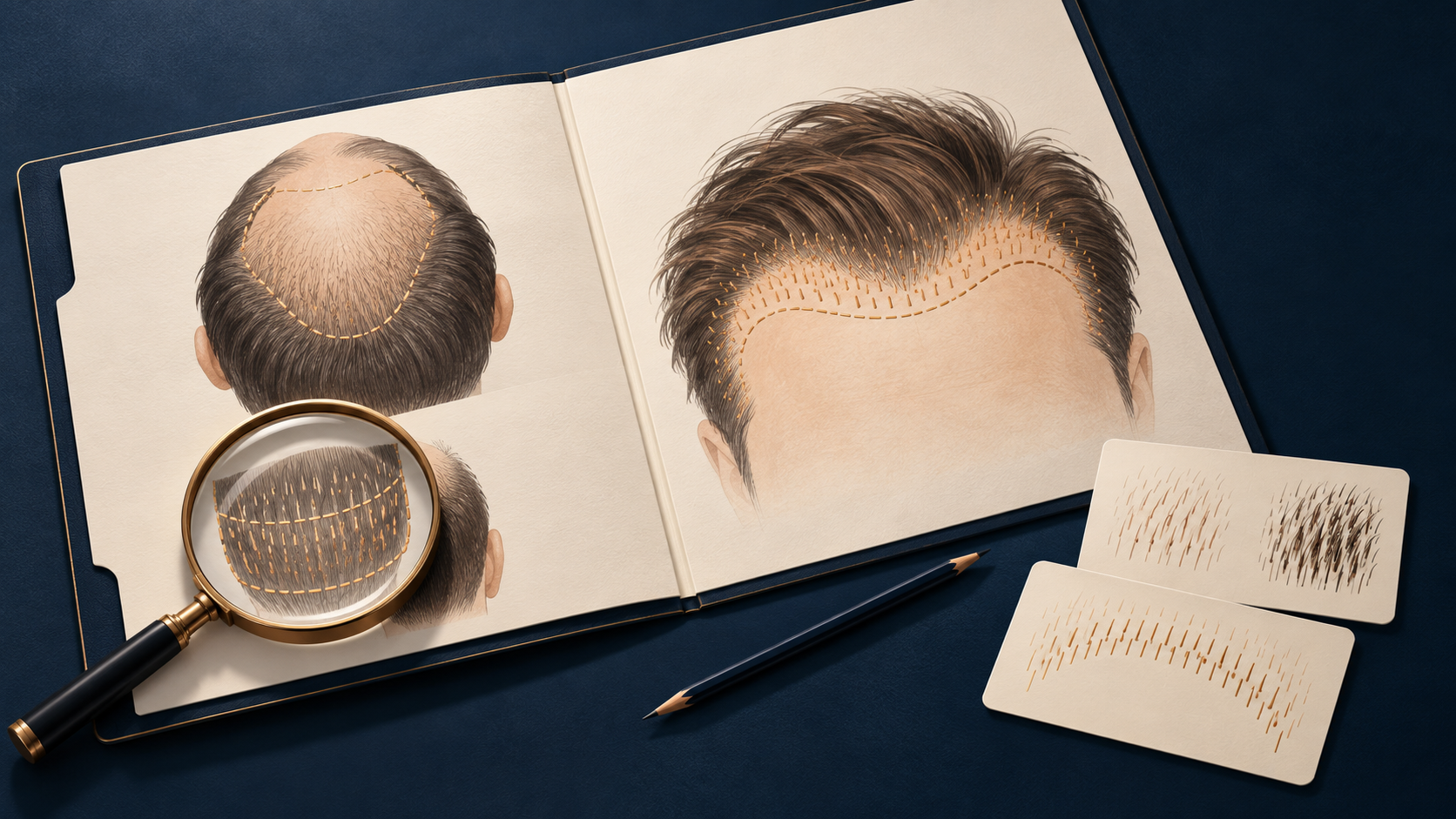
Hair transplant consultation should be more than a short conversation about graft numbers, technique and price. Its real purpose is to determine whether surgery is appropriate, what the donor area can support and whether the expected result can remain natural as hair loss progresses.
A good consultation may end with an operation plan. It may also lead to medical assessment, a period of observation or a decision not to proceed.
Hair Transplant Consultation Starts with Diagnosis
The first task is to understand the hair loss. When did it begin? Has it progressed slowly or changed rapidly? Is there a family pattern? Have any treatments been used, and is the scalp showing redness, scaling, itching or unusual shedding?
These questions help distinguish ordinary pattern hair loss from conditions that may require further evaluation. The entire scalp—not only the visibly thinning area—should then be examined.
The donor region must be assessed for density, hair calibre, follicular-unit distribution and miniaturisation. Long hair can conceal reduced density, while coarse or wavy hair may create stronger visual coverage than fine, straight hair.
This examination helps determine whether someone is a good candidate for a hair transplant. It also reveals whether the donor supply is strong enough to support the requested area.
Medical history matters as well. Previous operations, current medication, allergies, chronic health conditions and earlier hair procedures can affect surgical planning. If something is unclear, further medical or dermatological evaluation may be needed before a final decision.
The Plan Should Explain More Than Graft Numbers
A hair transplant consultation should connect donor capacity with the recipient goal. A graft estimate has little value unless it explains where those grafts will be placed, which areas receive priority and what level of density can realistically be created.
Hairline position and shape should be discussed in relation to age, facial proportions and future hair loss. A low or aggressive hairline may consume excessive grafts and become difficult to support if the natural hair continues to recede.
The plan should also explain whether the frontal area, mid-scalp and crown can be treated together. When donor capacity is limited, the front may need priority. The restrictions described in hair transplantation with a weak donor area cannot be solved simply by selecting a different technique.
Hair transplant practice guidelines recommend documenting donor adequacy, the planned hairline, expected results, the proposed graft number and the possible need for future procedures.
Questions That Should Be Answered Before You Leave
Before making a decision, the patient should understand:
- Why surgery is—or is not—recommended
- Who will perform each stage of the procedure
- Why a particular extraction and implantation approach has been selected
- How the graft estimate was calculated
- What level of density is realistic
- Whether another session may be needed
- How future hair loss may affect the result
- What recovery and follow-up will involve
Photographs, drawings and measurements can help explain the proposal, but they should not be used to promise an identical result.
A hair transplant consultation succeeds when the limits are as clear as the possibilities. The most valuable outcome is not always an operation date; it is a decision that protects both the patient’s appearance and the limited donor reserve.