Hair Transplant with a Weak Donor Area: Is It Possible?
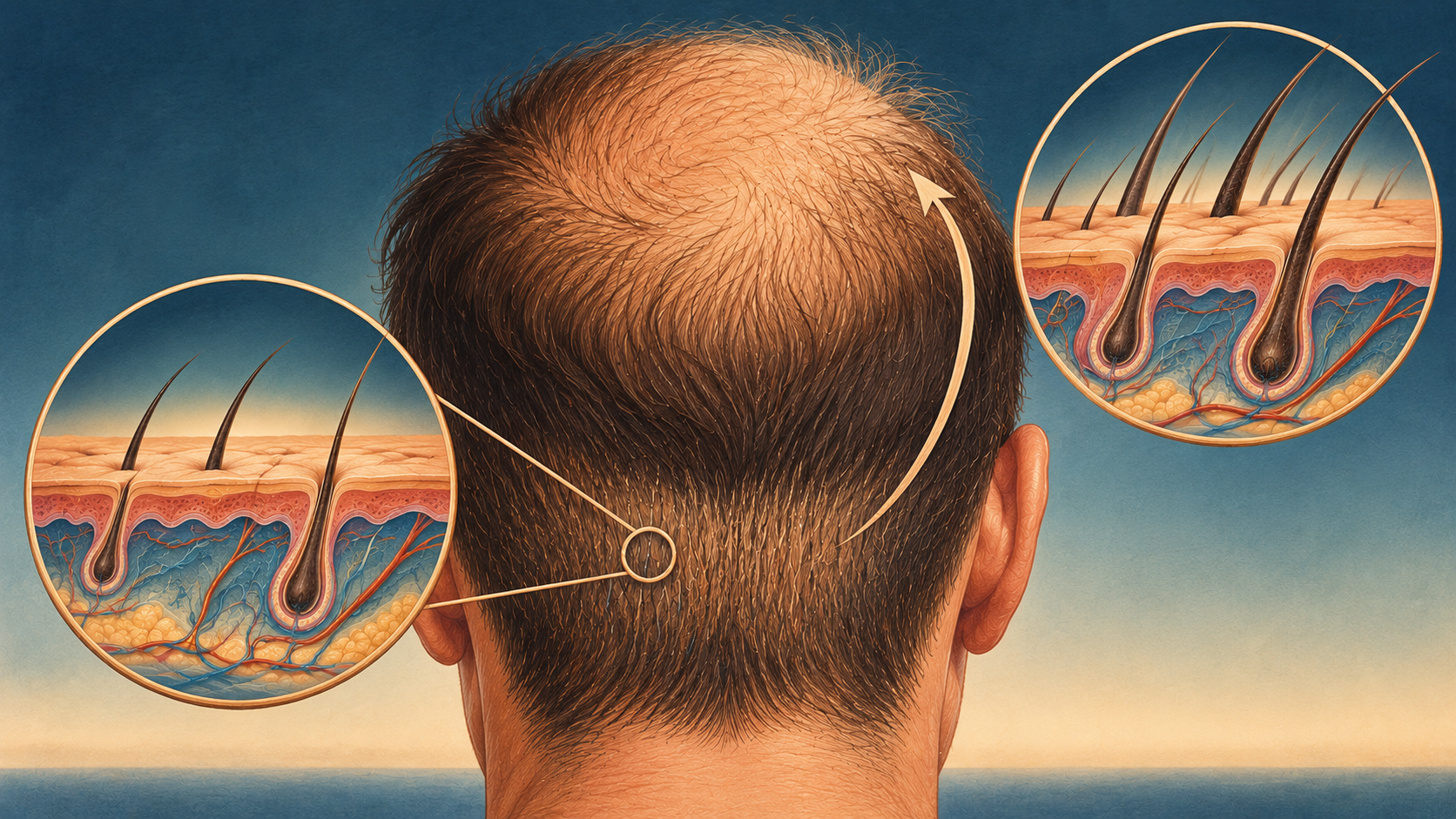
Hair transplant with a weak donor area may be possible in selected cases, but the operation cannot be planned as though the donor supply were unlimited. The first task is to understand what “weak” means for that individual scalp.
Low density is only one possibility. Fine hair shafts, widespread miniaturisation, an unusually narrow safe donor zone, previous harvesting or visible scarring can also reduce the number and quality of grafts available. Each of these findings affects the plan differently.
Hair Transplant with a Weak Donor Area Begins with Measurement
The donor area should not be judged from a photograph or by counting visible hairs in one small section. Its density, hair calibre, follicular-unit distribution and signs of miniaturisation need to be examined across the entire proposed harvesting zone.
A donor area may look dense when the hair is long but reveal significant spaces after trimming. The opposite can also happen: curly or coarse hair can provide strong visual coverage even when the numerical density is not especially high.
Miniaturisation is particularly important. If follicles within the proposed safe zone are becoming progressively thinner, they may not provide the long-term stability expected from transplanted hair. This issue is also central when assessing a hair transplant with diffuse thinning.
Previous procedures must be included in the calculation. The number of grafts already removed, the distribution of extraction points and the remaining donor homogeneity may matter more than the graft count written in an old operation report.
A Smaller Operation Can Still Be the Right Operation
A hair transplant with a weak donor area does not always need to cover every thinning region. A limited plan may concentrate grafts in the frontal third, where a moderate improvement can create a stronger visual frame for the face.
The crown generally requires a large number of grafts because of its surface area and spiral growth pattern. Attempting to cover both the front and crown with a restricted donor supply may spread the grafts so thinly that neither area receives a meaningful improvement.
Hair characteristics can sometimes support a conservative plan. Coarse, wavy hair with a low contrast against the scalp usually creates more visual coverage than fine, straight hair. However, favourable characteristics cannot turn an unstable donor area into a safe one.
Hair transplant practice guidelines emphasise assessing miniaturisation and the limits of the safe donor zone before harvesting. The maximum number of grafts is therefore personal; it should not be selected from a standard package.
When Should a Weak Donor Area Rule Out Surgery?
Surgery may be inappropriate when there is no reliably stable harvesting zone, the remaining density is too low, previous extraction has already produced visible depletion or the requested coverage cannot be achieved without overharvesting.
In these situations, reducing the graft target does not always solve the underlying problem. Another procedure may worsen the donor appearance while producing only a minor change in the recipient area.
It can be more responsible to postpone a hair transplant or decide against surgery than to use grafts simply because some can technically be extracted.
A hair transplant with a weak donor area should be judged by the quality of the achievable result, not by whether an operation is technically possible. Protecting the hair that remains is sometimes the most valuable part of the plan.