Male vs. Female Hair Loss Assessment: Key Differences
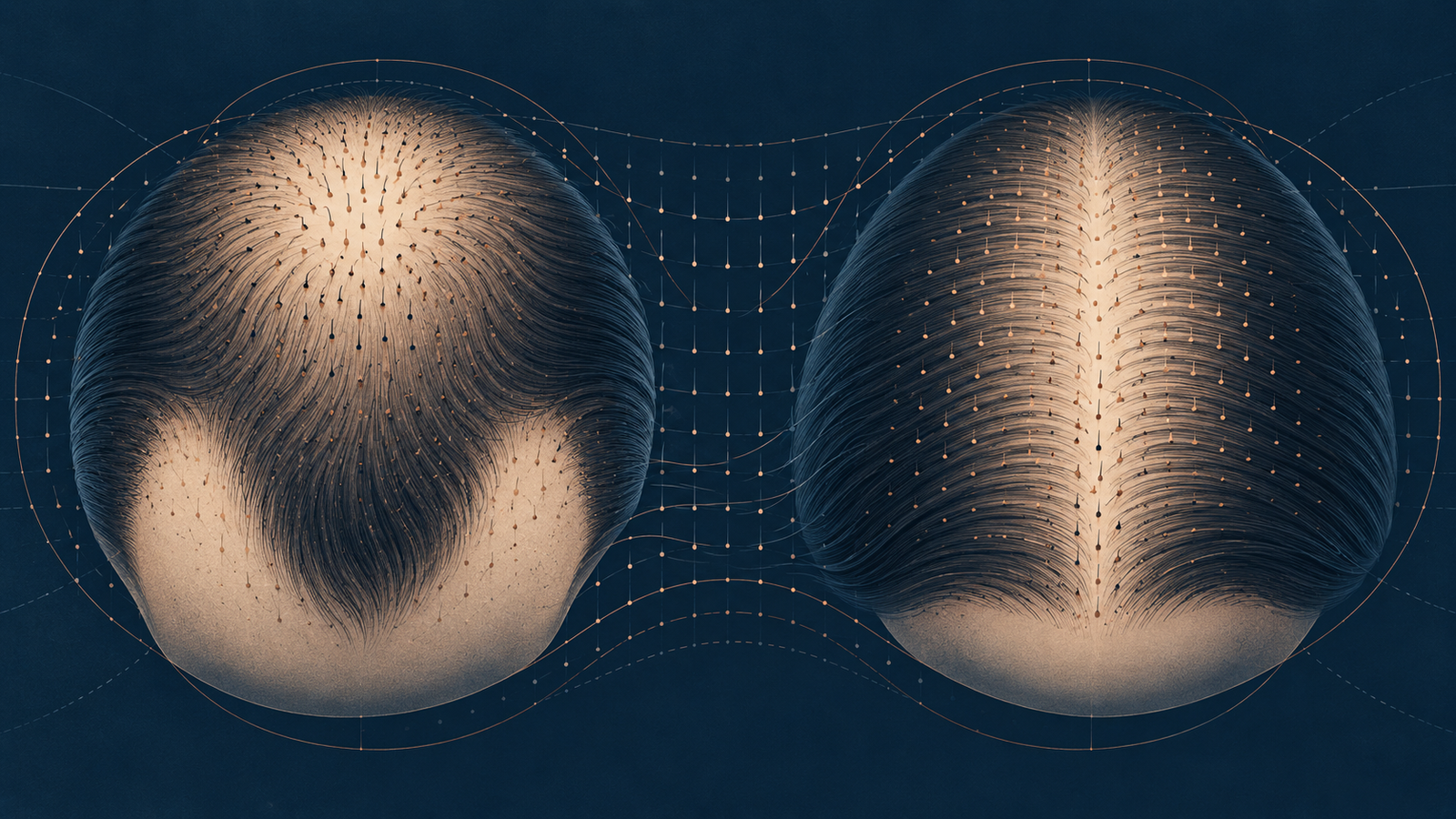
Male vs. female hair loss assessment should never be reduced to choosing a different chart for each patient. Men and women often experience recognizable patterns of hair loss, but pattern alone does not explain why the loss is happening or whether a hair transplant is appropriate.
During an assessment, I look at how the hair loss began, how quickly it progressed, whether shedding is still active and whether the donor area appears stable. These details matter more than simply placing a patient within a classification stage.
Male vs. Female Hair Loss Assessment: Different Patterns
In men, androgenetic alopecia commonly affects the temples, frontal hairline and crown. The Hamilton–Norwood scale can help describe the visible stage of the condition. However, two men at the same stage may have very different donor density, hair shaft thickness and expectations for future hair loss.
Women often retain the front edge of the hairline while losing density across the top or central scalp. A widening part, increased scalp visibility or a noticeably thinner ponytail may be early signs. The Ludwig scale is commonly used to describe this pattern.
These are useful guides, but they are not complete diagnoses. A man may develop diffuse thinning instead of a typical receding pattern, while a woman may experience noticeable temporal recession. Sudden shedding, small bald patches, scalp inflammation or thinning within the donor region require a broader medical evaluation.
The American Academy of Dermatology also notes that several conditions can resemble female pattern hair loss. This is why an accurate diagnosis should come before decisions about surgery.
Medical History and Donor Stability Change the Picture
A proper assessment includes questions about when the problem started, recent illnesses, medication use, nutrition, family history and scalp symptoms.
For women, pregnancy and the postpartum period, menopause, iron deficiency, thyroid conditions and other systemic factors may need to be considered. Irregular menstrual cycles, acne or changes in body hair may also justify further investigation by a qualified physician. This does not mean that every woman with hair loss has a hormonal condition; it means the history should not be ignored.
Men can also experience hair loss unrelated to genetics. Rapid diffuse shedding, redness, scaling, discomfort or clearly defined patches should not automatically be classified as male pattern baldness.
The donor area is just as important. Many men have a more clearly defined zone of resistant follicles, but its density and degree of miniaturization still need to be measured. Some women experience diffuse thinning that extends into the donor area. If those follicles are also becoming weaker, their long-term value for transplantation may be limited.
Understanding the difference between the follicle beneath the skin and the visible hair above it is useful here. I explain this in more detail in Hair Follicle vs. Hair Shaft.
Why Classification Is Not a Treatment Plan
Male vs. female hair loss assessment also influences hairline design. For many male patients, the objective is to rebuild the frontal frame while preserving enough donor capacity for possible future thinning in the mid-scalp or crown.
In women, the natural frontal border may already be intact. The priority may instead be improving density behind that border or along an increasingly visible part. Applying a standard male hairline plan in this situation would not address the real concern.
Classification systems give us a shared language, but they cannot determine the exact graft number, donor capacity or suitability for surgery. Head size, hair calibre, colour contrast, progression speed and the stability of surrounding hair can completely change the plan.
That is why male vs. female hair loss assessment must remain personal. The chart may describe the pattern, but the patient’s own hair characteristics determine what can be achieved safely and naturally. For a broader explanation of this process, read Hair Loss Assessment Before a Hair Transplant.