Safe Donor Area in Hair Transplantation: How Is It Defined?
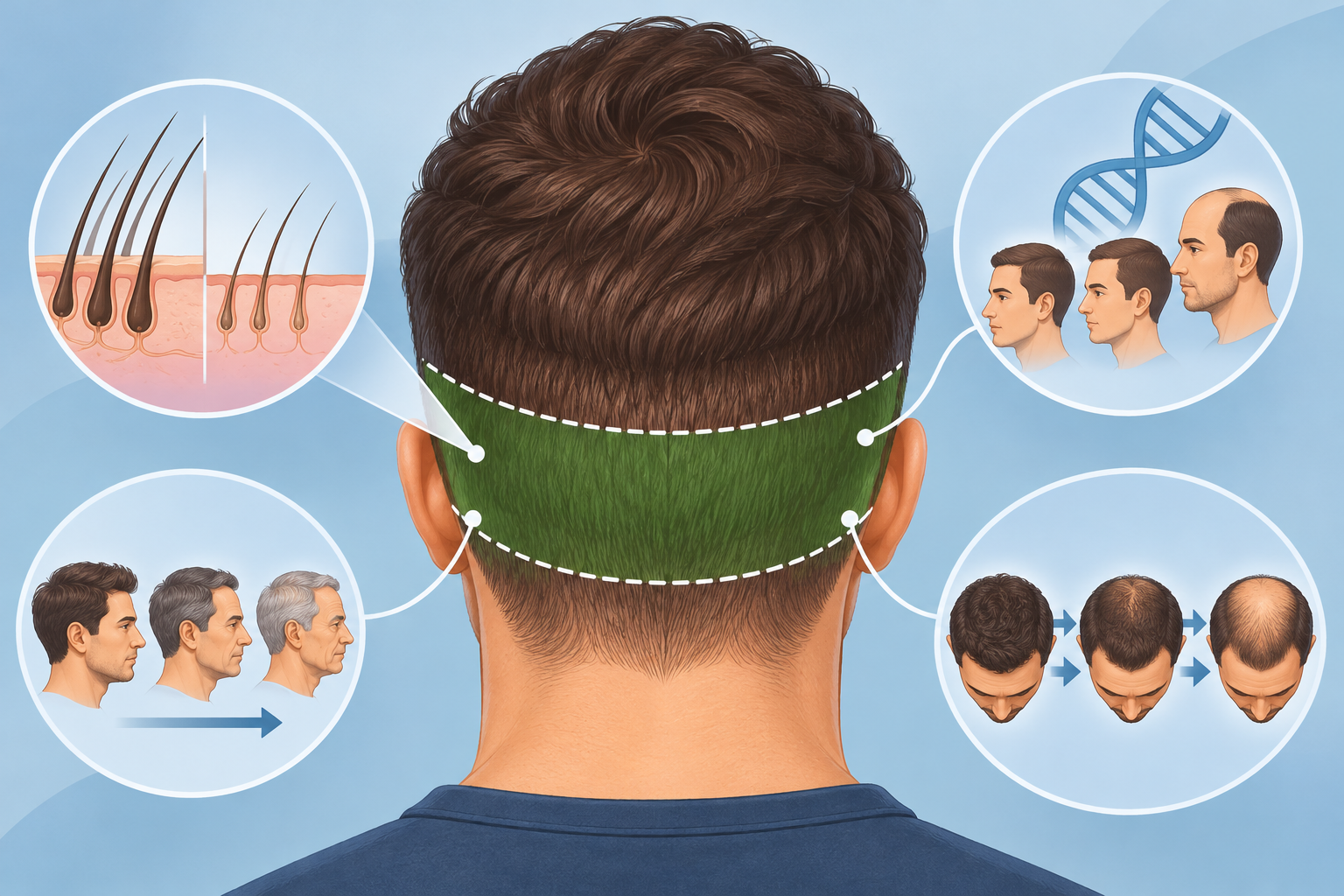
Safe donor area in hair transplantation refers to the part of the scalp from which follicles are expected to retain their characteristics after being transferred. It is generally located across selected portions of the back and sides of the head, where hair tends to be more resistant to androgenetic hair loss.
The important word here is not “donor,” but “safe.”
Hair may be present across a large area of the occipital and temporal scalp, yet not all of it is equally suitable for transplantation. Some follicles may already be becoming thinner. Others may lie close to a boundary that will recede as the patient’s hair loss progresses.
If unstable follicles are harvested, they may later weaken after transplantation. The donor region may also develop visible thinning as the less stable hair surrounding the extraction sites is gradually lost.
This is why the safe zone should never be identified simply by drawing a standard band across the back of every patient’s head.
Safe Donor Area in Hair Transplantation Must Be Defined Individually
Classical donor diagrams provide a useful starting point, but they cannot replace an individual scalp assessment. The width, height and stability of the donor fringe differ considerably from one person to another.
Some patients have a broad occipital zone with strong density and little variation in hair calibre. Others show thinning near the nape, above the ears or along the upper border where the donor region approaches the crown.
Retrograde alopecia is particularly important. In this pattern, thinning progresses upward from the neck or around the ears. Hair in these areas may initially appear usable, especially when it is long, but a shorter examination can reveal a clear reduction in density or calibre.
Diffuse miniaturisation creates another concern. If thinner follicles are distributed throughout the proposed harvesting zone, there may be no sufficiently stable area from which a large number of grafts can be removed safely.
A recent scientific review on the patient-specific definition of the safe donor area describes the zone as a dynamic structure rather than a fixed geometric template. A conservative central region may be stable in many patients, while peripheral areas should be included only after careful assessment.
Trichoscopy can help identify variation in hair shaft diameter, follicular-unit density and signs of miniaturisation. Measurements should be taken from several occipital and temporal points because a single dense section does not represent the whole donor area.
Age, Family History and Future Hair Loss Change the Borders
A donor assessment is not limited to what the scalp looks like today. It should also consider what may happen over the following years.
This is especially relevant in younger patients. Their hair-loss pattern may still be developing, and the lower or upper donor boundaries may become narrower over time. A generous zone marked at the age of 23 may not remain equally secure at 35 or 45.
Family history cannot predict the future perfectly, but it provides useful context. Extensive hair loss among close relatives, early onset of thinning and rapid progression may all support a more conservative donor boundary.
The relationship between the donor area and the crown must also be considered. As crown loss expands downward, the upper edge of the presumed donor zone can become less reliable. Retrograde thinning can simultaneously move upward from the neck, narrowing the stable band from below.
This is why I evaluate the hair transplant donor area as a lifetime reserve rather than a one-session supply. The boundaries determine not only where grafts can be taken, but also how much donor capacity should remain after the first operation.
Previous procedures can make this assessment more complex. Old FUE extraction points, strip scars and uneven harvesting may reduce the usable surface. A region that was considered safe during an earlier operation should not automatically be treated as safe again without re-examination.
A Larger Donor Zone Is Not Always a Better Donor Zone
Expanding the harvesting boundaries may increase the available graft number in the short term. However, those additional grafts have limited value if their long-term stability is uncertain.
Hair close to the neck or ears may sometimes be useful for creating soft transitions, temples or selected hairline details because it is often finer. Yet these peripheral follicles should not be described as universally permanent. Their use depends on the individual pattern and the purpose of the grafts.
The safest approach is usually to begin with a conservative central zone, assess the surrounding regions carefully and expand only when the findings support it. When donor miniaturisation, retrograde thinning or a strong risk of extensive future loss is present, the boundaries should become smaller rather than larger.
This may reduce the number of grafts available for one operation. It also reduces the risk of transferring unstable hair or leaving the back of the scalp visibly depleted.
Safe donor area in hair transplantation is therefore not the largest area from which grafts can technically be extracted. It is the area that offers the most defensible balance between long-term follicle stability, donor appearance and the patient’s future needs.