Hair Transplant Donor Area: Why Is It a Limited Resource?
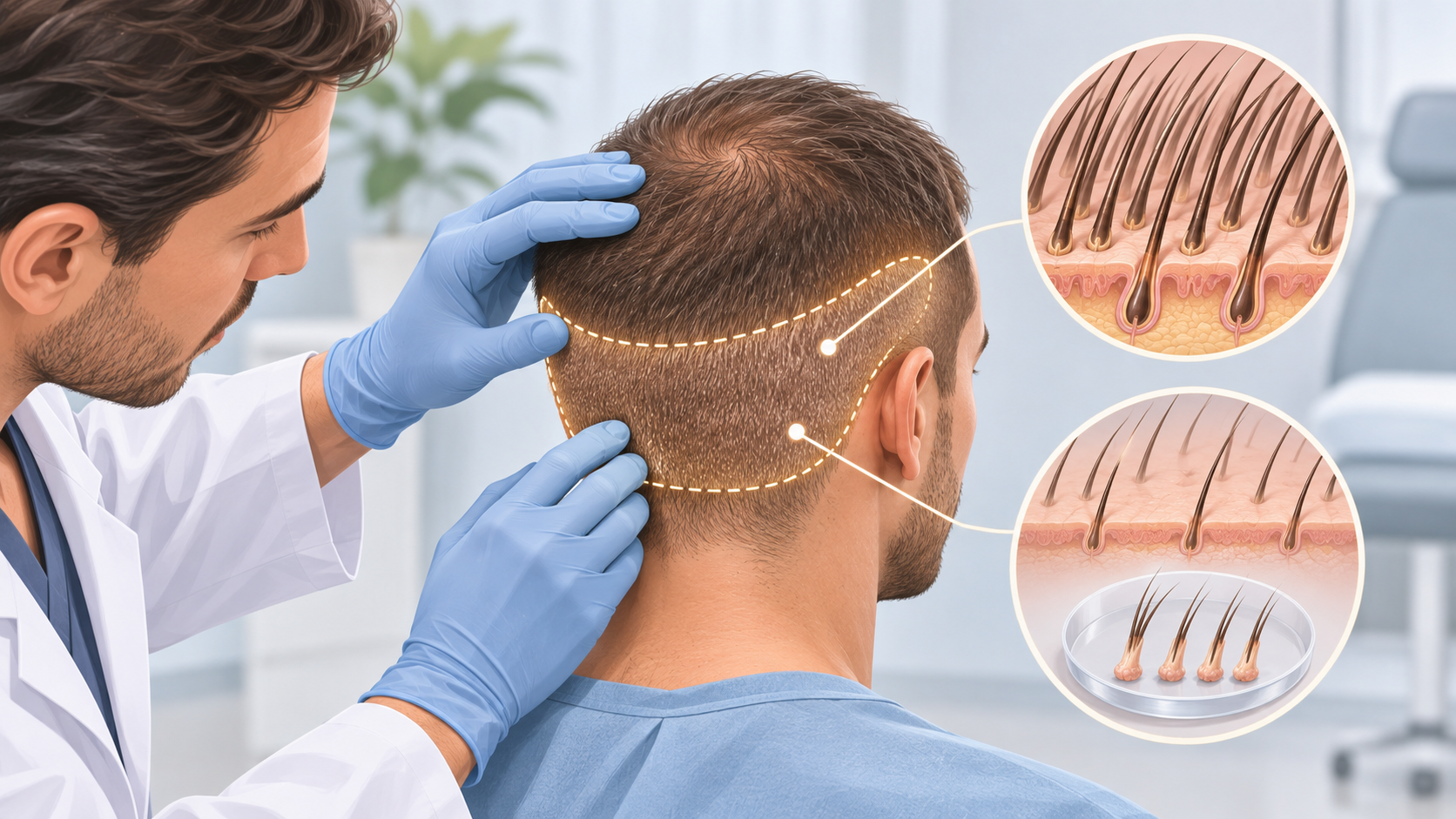
Hair transplant donor area is the foundation of every surgical hair restoration plan. It usually includes selected parts of the back and sides of the scalp where follicles are more resistant to androgenetic hair loss. These follicles can be relocated to thinning areas, but they cannot be replaced once they have been extracted.
This is why I do not view the donor region simply as the place from which grafts are taken. It is a limited reserve that may need to support the patient not only during the first operation, but also through the future progression of hair loss.
A large recipient area does not automatically mean that a large number of grafts can be used. The surgical plan must remain within the capacity of the donor area while preserving a natural appearance at the back and sides of the head.
Hair Transplant Donor Area Does Not Renew Itself
When a follicular unit is removed through FUE, another follicular unit does not grow in its place. The surrounding hair may conceal the extraction point, but the total follicular-unit density of that area has been reduced permanently.
This distinction matters because a donor region can look relatively dense before surgery, especially when the hair is long. If too many grafts are removed or extraction points are concentrated in particular sections, the scalp may become visible after the hair is shortened. Patchy thinning, sharp differences in density and an irregular “moth-eaten” appearance are possible signs of overharvesting.
The number of grafts that can be removed safely is therefore not determined by a standard package. Density must be measured across several parts of the donor zone. Hair shaft calibre, curl, colour contrast, the number of hairs in each follicular unit and the patient’s preferred hairstyle also influence how well the remaining hair will provide coverage.
Coarse or wavy hair can sometimes preserve a stronger visual density after extraction. Fine, straight hair with a high contrast against the scalp may reveal the same reduction much more clearly. Two patients with an identical follicular-unit count may consequently have very different donor capacities.
Professional hair transplant practice guidelines recommend examining donor density, calibre, miniaturisation and the boundaries of the safe donor zone before harvesting. These boundaries must be determined individually rather than copied from a standard diagram.
The Safe Donor Zone Is Not the Same for Everyone
The term “safe donor zone” describes the portion of the scalp expected to remain relatively stable despite the progression of androgenetic hair loss. However, its boundaries are not fixed.
Some patients have a broad and dense stable zone. Others have retrograde thinning near the neck, recession above the ears or miniaturisation that extends into areas traditionally treated as permanent. Age, family history and the likely future pattern of hair loss must therefore be considered during donor mapping.
This is particularly important in younger patients. The donor area may appear strong at the time of the first assessment, but its stable boundaries can become clearer as the pattern develops. Extracting grafts from peripheral or uncertain regions may provide more grafts today while increasing the risk that those hairs will thin later.
A detailed hair transplant consultation should also include previous procedures. The number of grafts reported after an earlier operation does not tell the whole story. Their distribution, the remaining density, visible scarring and whether the same sections were harvested repeatedly may be even more important.
When considering a hair transplant with a weak donor area, the objective may need to be reduced. Concentrating grafts in the frontal region can sometimes create more visual value than spreading a limited supply across the hairline, mid-scalp and crown.
A Donor Budget Must Be Planned for a Lifetime
Hair loss can continue after transplantation. A patient who receives a dense frontal procedure today may require additional support behind that area in the future. If most of the available reserve has already been used, there may be too few stable grafts left to maintain a coherent appearance.
The first operation should therefore leave room for what may happen next. This does not mean that every patient will require another procedure. It means that the plan should not depend on the assumption that hair loss will stop.
Hair transplant donor area should be managed like a lifetime budget. The goal is not to extract the highest possible number in a single session. It is to use the appropriate number, distribute the extractions evenly and preserve enough density for the donor region to remain natural.
A successful hair transplant is judged from every angle. Improving the front of the scalp while visibly weakening the back is not a balanced result. Protecting the donor reserve is therefore not a secondary concern—it is one of the central responsibilities of long-term hair transplant planning.