Does Donor Hair Grow Back After FUE?
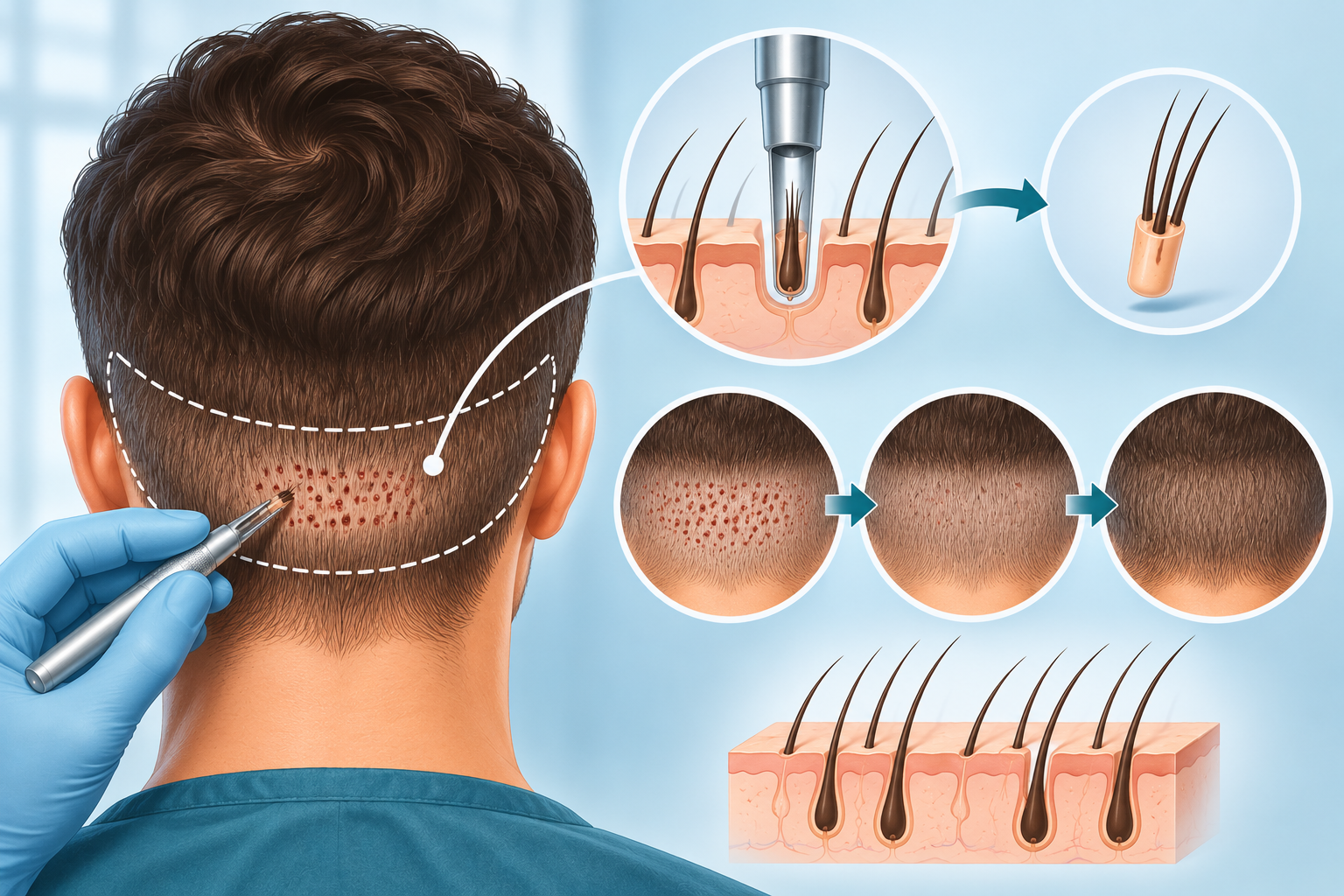
Does donor hair grow back after FUE? The short answer is that a follicular unit removed completely during a standard FUE procedure does not grow back in the location from which it was extracted.
This does not mean that the donor area must look visibly empty after surgery. When the extractions are distributed correctly and remain within the capacity of the donor region, the surrounding hair can grow over the small extraction points and preserve a natural appearance.
This visual recovery is sometimes mistaken for follicle regeneration. In reality, the donor scalp has healed and the hairs that were deliberately left behind are providing coverage. The number of follicular units in the harvested area has still been permanently reduced.
Does Donor Hair Grow Back After FUE or Is the Area Being Covered?
During FUE, a small punch is used to separate and remove an individual follicular unit from the surrounding tissue. The graft is then prepared and transferred to the recipient area.
If the complete follicular unit has been extracted, it is no longer present in the donor site. The opening heals as a very small circular scar, but a new follicular unit does not normally form within it.
Several changes can nevertheless make the donor region look considerably better over the following weeks and months.
Redness and crusting gradually disappear. The short hair around the extraction points grows longer. Small wounds contract as they heal, and the remaining shafts overlap the areas where grafts were removed. If extraction was evenly distributed, the reduction may be difficult to notice at an ordinary hairstyle length.
The International Society of Hair Restoration Surgery answers the question of whether the FUE donor area grows back directly: removed donor hair is not replaced. This is one reason donor follicles must be used judiciously.
Hair length can create a particularly strong illusion. A donor area shaved closely after surgery exposes the extraction pattern. Several months later, longer surrounding hair may conceal much of the scalp even though no new follicles have appeared in the extraction sites.
This is why before-and-after donor photographs should ideally be compared at similar hair lengths, angles and lighting conditions.
Temporary Donor Shedding Is Different from Extracted Hair
Some patients experience temporary shedding of hair that was not extracted. This is usually described as donor-site effluvium or donor shock loss.
The follicles remain within the scalp, but the stress of surgery, local inflammation or a temporary change in the hair cycle can cause their shafts to shed. The donor region may then look thinner several weeks after the operation, even when the extraction pattern itself was conservative.
A recent review of FUE donor-site complications describes donor-site effluvium as a temporary condition that commonly appears within the first weeks and may recover over the following months.
When these resting follicles resume their growth cycle, new shafts can emerge. This is genuine regrowth from follicles that never left the donor area. It should not be confused with the regeneration of follicles that were removed and transplanted.
Transection creates another source of confusion. If a follicle is incompletely separated, part of its structure may remain in the donor scalp. Some partially injured follicles may produce hair again, depending on the level and extent of the injury.
However, transection is not a predictable method for replenishing the donor area. It can also damage the graft intended for transplantation. Standard FUE planning should therefore not assume that extracted or transected follicles will regenerate.
Healing Does Not Restore the Original Density
The donor area can heal well without returning to its original follicular density. These are two different outcomes.
When a limited number of grafts is removed from a sufficiently dense safe donor area, the remaining hair can conceal the reduction. When too many grafts are taken, no amount of wound healing can restore the follicles that have been removed.
Overharvesting may leave persistent thinning, irregular gaps and visible differences between harvested and unharvested sections. These problems become more noticeable when the hair is short or when future hair loss narrows the stable donor zone.
For this reason, the hair transplant donor area must be treated as a non-renewable reserve. The operation should not aim to remove as much as technically possible, but to take an appropriate number while preserving sufficient coverage.
Does donor hair grow back after FUE? Completely extracted follicles do not normally return. What grows is the surrounding hair that was left in place—and, in cases of temporary shock loss, hair from follicles that remained in the scalp.
The long-term appearance of the donor area therefore depends on careful measurement, even extraction distribution and respect for the patient’s individual donor capacity.