Hair Transplant Refusal: Why Might a Clinic Say No?
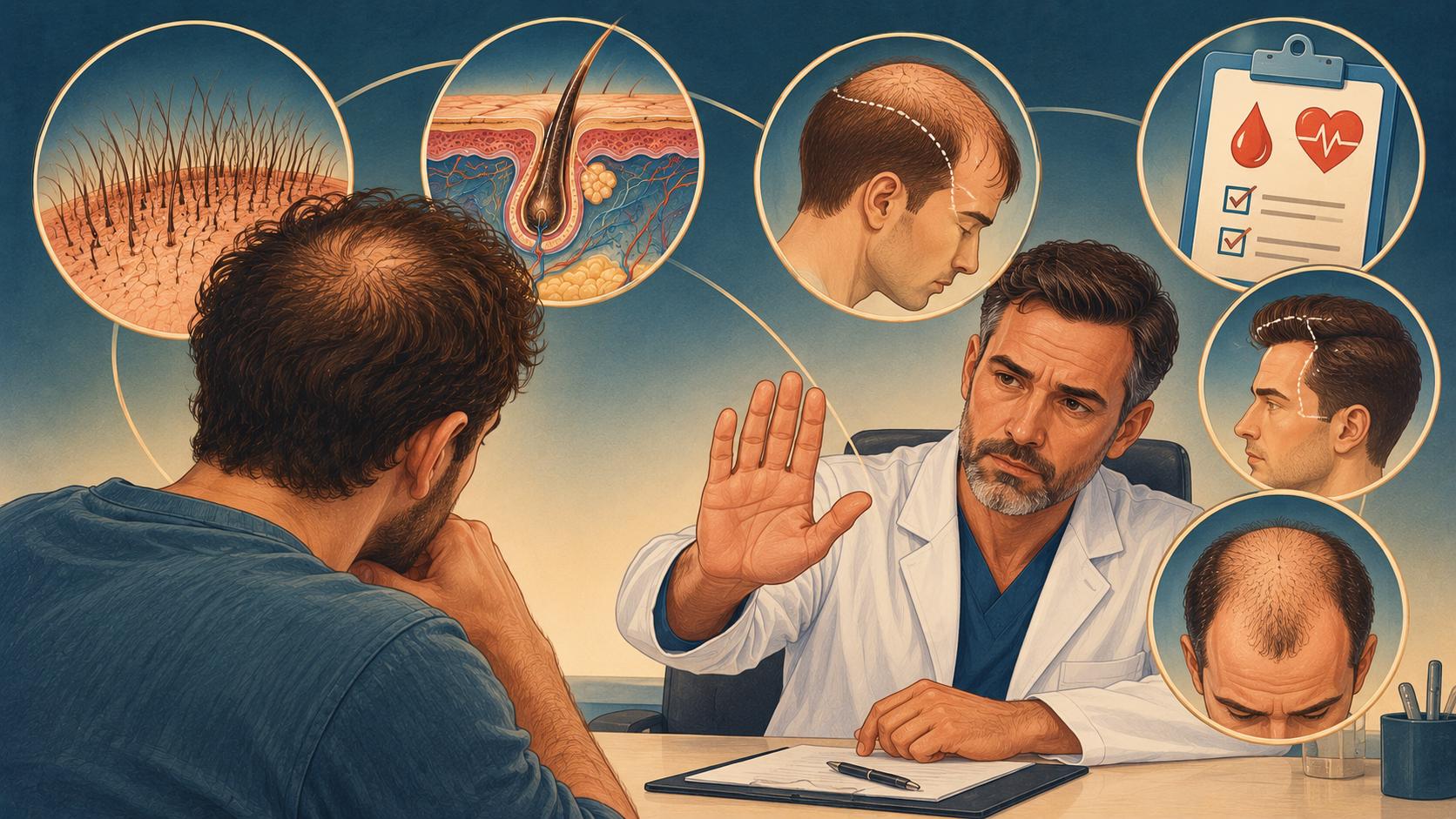
Hair transplant refusal can feel disappointing, especially when someone has already decided that surgery is the next step. However, a clinic saying “no” does not necessarily mean that nothing can be done. Sometimes it means that surgery is unlikely to provide a safe, natural or lasting result under the present conditions.
A responsible assessment is not limited to deciding how many grafts can be extracted. It must consider the diagnosis, the stability of hair loss, the quality of the donor area, scalp health, medical history and whether the expected result is realistically achievable.
Hair Transplant Refusal May Begin with the Diagnosis
Not every type of hair loss should be treated surgically. Diffuse shedding, inflammatory scalp conditions, scarring alopecia and widespread miniaturisation may require further investigation or medical management before transplantation is considered.
Proceeding without a clear diagnosis can place transplanted and existing hair at risk. This is why a detailed hair transplant consultation should examine both the recipient and donor areas rather than concentrating only on the visible thinning.
Timing also matters. When hair loss is progressing rapidly, the pattern seen today may change considerably over the following years. Surgery performed too early can leave transplanted hair surrounded by newly thinned areas. In such cases, it may be more appropriate to postpone a hair transplant and reassess the pattern after a period of observation or treatment.
Donor Capacity Must Match the Requested Result
The donor area is limited. It cannot replace every hair that may be lost during a lifetime, and it should not be treated as an unlimited source of grafts.
A clinic may recommend against surgery when the safe donor zone is narrow, density is low or miniaturisation extends into the proposed harvesting area. Previous procedures may also have reduced the remaining capacity. A hair transplant with a weak donor area is sometimes possible, but only when the intended coverage and density remain realistic.
The same applies to expectations. A patient requesting full coverage and very high density despite advanced hair loss may be asking for more than the donor area can provide. The clinical review on surgical candidacy in pattern hair loss identifies unstable loss, inadequate donor hair, certain scalp conditions and unrealistic expectations among the reasons transplantation may be unsuitable.
“No” Can Mean “Not Now” or “Not This Plan”
Hair transplant refusal is not always permanent. A scalp condition may first need treatment, hair loss may need time to stabilise or the surgical objective may need to become more conservative.
In other cases, avoiding surgery may be the safest decision. Performing an operation simply because graft extraction is technically possible can create donor depletion without delivering a meaningful improvement.
A trustworthy clinic should be prepared to explain what limits the operation and whether those limits could change. Hair transplant refusal should therefore be understood as part of careful planning—not as the absence of a solution, but as a decision to protect the patient from an unsuitable one.