Donor Area Overharvesting: What Does It Mean?
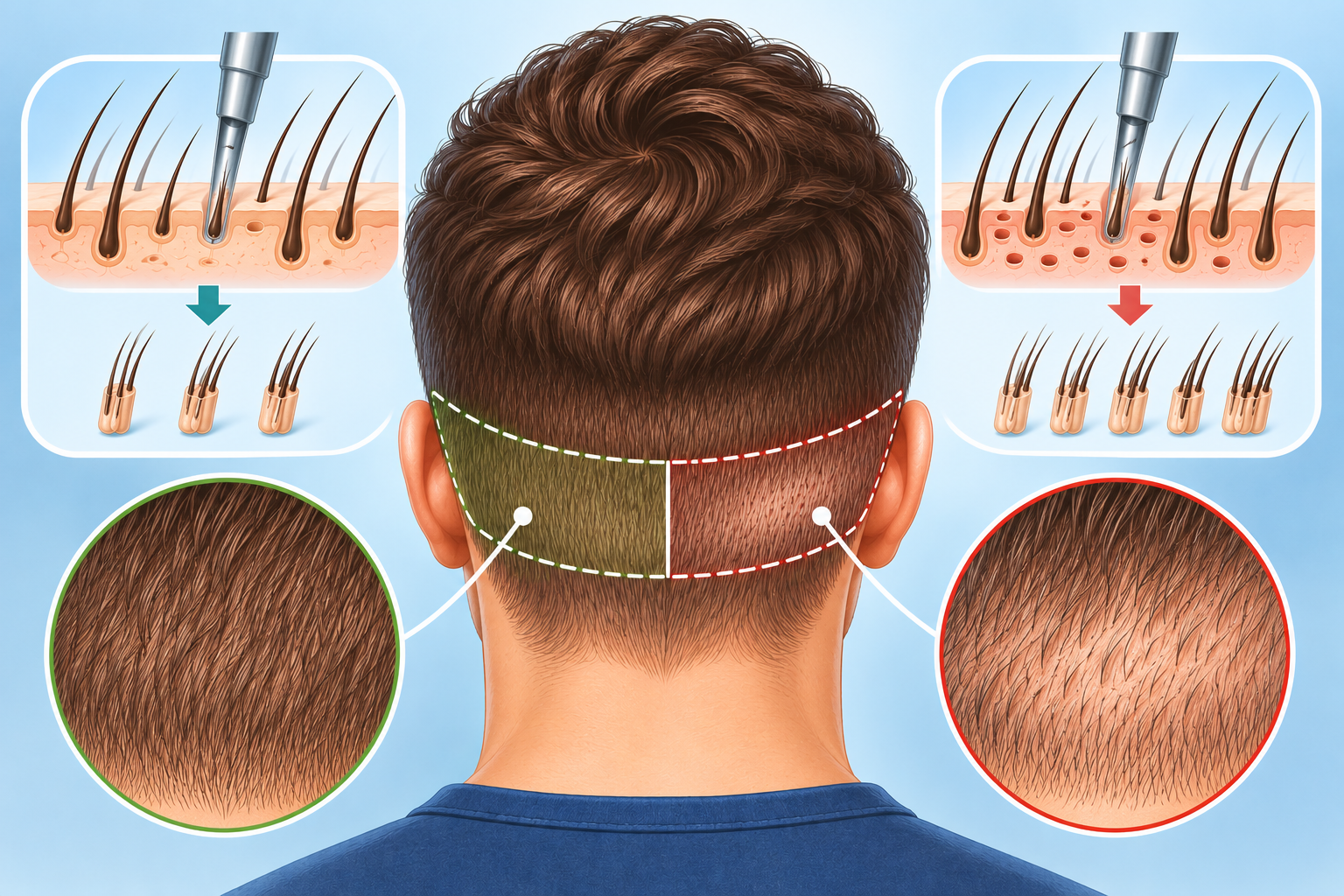
Donor area overharvesting occurs when follicular units are removed beyond the level that the remaining hair can conceal naturally. It may produce general thinning, irregular gaps, sharp changes in density or a patchy appearance across the back and sides of the scalp.
The problem cannot be defined by one universal graft number. Removing 3,000 grafts may be acceptable for one patient and excessive for another. The outcome depends on the original donor density, size of the safe zone, hair characteristics, previous surgery and the way extraction sites are distributed.
This is why the question should not be “How many grafts can technically be removed?” It should be “How many can be removed while the donor area remains natural?”
Donor Area Overharvesting Is Not Only About the Total Graft Number
A donor area can be overharvested even when the total number of grafts does not appear unusually high.
If extractions are concentrated in a small section, that section may become visibly thinner than the surrounding scalp. This can create a “window” of reduced density or a moth-eaten pattern made up of multiple irregular gaps.
Uniform distribution is therefore essential. Each extraction reduces the number of follicular units in that location permanently. Adequate spacing between sites allows the remaining hair to continue providing coverage.
Original density also matters. A patient with a naturally dense donor region may tolerate a greater numerical reduction than someone who started with fine hair and low density. Hair calibre, curl, colour contrast and usual hairstyle affect how easily the scalp becomes visible.
Coarse or wavy hair generally provides stronger visual coverage. Fine, straight hair may reveal a comparable loss much sooner. Patients who prefer very short haircuts may also notice depletion and small FUE scars more easily.
A current review of FUE complications and donor-site overharvesting describes visible thinning, windowing and permanent donor depletion among the possible consequences of excessive or poorly distributed extraction.
The safe donor boundaries must also be respected. Taking grafts from unstable areas near the neck, ears or crown may temporarily increase the available number. As the surrounding hair thins later, those extraction sites and density differences can become more apparent.
How Can Donor Overharvesting Be Recognised?
A donor area should not be judged during the first days after surgery. The hair is short, the scalp may be red and the extraction points are deliberately visible. Temporary donor shock loss can also make the region look thinner during the early recovery period.
A more meaningful assessment becomes possible after healing and sufficient hair growth.
Possible signs include persistent scalp visibility, uneven patches, abrupt transitions between harvested and untouched zones, reduced coverage despite reasonable hair length and numerous pale extraction marks that become obvious with a short haircut.
Comparisons should be made with similar lighting, hair length and camera angle. Longer hair can hide depletion that becomes visible immediately after trimming.
The earlier hair transplant donor area assessment is important because the number of grafts alone cannot explain the result. Density before surgery, follicular-unit distribution and the stable area available for extraction must also be known.
The safe donor area adds another layer. A donor region can appear dense but still contain peripheral follicles that are unlikely to remain stable throughout the patient’s lifetime.
Can an Overharvested Donor Area Be Repaired?
The first step is usually to avoid further aggressive extraction. Another FUE session performed without a new donor assessment may enlarge the depleted areas and reduce the remaining options.
Longer hairstyles can provide camouflage in mild cases. Scalp micropigmentation may reduce the contrast between the hair and exposed scalp, particularly when the patient prefers a shorter cut. Its suitability depends on skin tone, scarring, remaining density and the quality of the treatment.
Selected patients may be considered for limited transplantation into depleted donor sections using remaining scalp, beard or body hair. However, using more grafts to repair the donor area also consumes an already restricted supply. The potential improvement must be weighed against the cost to the remaining reserve.
The original follicles removed during FUE do not simply return. As explained in the article on whether donor hair grows back after FUE, healing and surrounding hair growth may improve the appearance without restoring the lost follicular density.
Donor area overharvesting is therefore easier to prevent than to correct. Careful measurement, conservative boundaries, even extraction distribution and long-term planning are more valuable than reaching the largest possible graft count in one session.